Influencer Campaign Report Template: From Posts to Business Decisions
A practical reporting template for marketers who need to explain what happened, what the data can actually support, and what to change next—not paste platform screenshots into a deck.
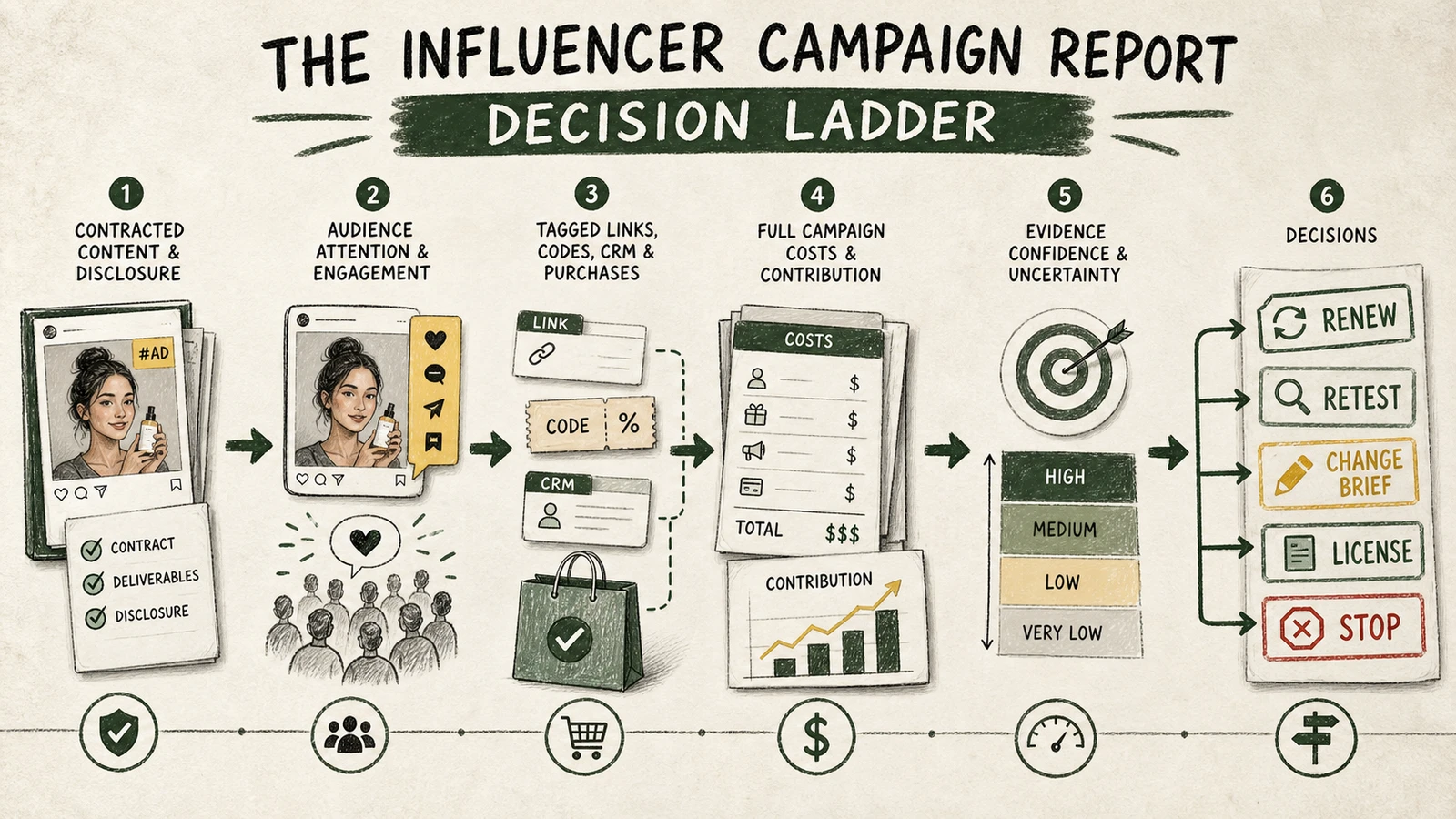
An influencer campaign report should help someone make a decision. If it only proves that posts went live and impressions happened, it is an archive—not a report. Copy the executive summary first, then use Sections 1–7 as the working sheets behind it.
The reporting sequence I use is:
Decision and objective
Contracted versus delivered work
Audience and content response
Tracked business outcomes
Cost and contribution
Evidence confidence and limitations
Keep, change, test, or stop
That sequence prevents the prettiest metric from becoming the conclusion.
Write the decision before collecting metrics. “Decide whether to renew three creators for a product launch” produces a different report from “learn which message earns qualified saves.”
Compact filled example — fictional
Campaign: Atlas Notes creator pilot
Decision: Renew, retest, or stop four tutorial creators
Objective/audience: Qualified trials from small operations teams
Dates/cutoff: May 1–31; conversion data through June 30
What worked: Problem-first tutorials from two creators produced 23/31 activations
What did not: One broad productivity Reel created reach but 1 activation
Caveat: No holdout; results are tracked/assisted, not proven incremental
Decision: Renew two creators, retest one with a narrower brief, stop one
Owner/date: Campaign lead / July 3
Reversal condition: CRM quality or 60-day retention differs materially by creator
This is not a benchmark. It demonstrates the minimum evidence needed to move from metrics to an owned decision.
Section 1: reconcile scope and delivery
Creator
Contracted asset
Due
Live URL
Delivered
Accepted
Disclosure checked
Usage-rights window
Payment status
Fill in
—
—
—
—
—
—
—
—
Record revisions, make-goods, removals, whitelisting/partnership-ad authorization, raw files, exclusivity, and late delivery separately. A post can perform well and still create operational or rights risk.
Use links or evidence receipts rather than a “complete” checkbox with no artifact.
Section 2: preserve raw performance data
Creator/asset
Followers at capture
Reach
Impressions
Views
Watch time/retention
Likes
Comments
Saves
Shares
Source/captured
Fill in
—
—
—
—
—
—
—
—
—
—
Do not compare unlike denominators silently. A view-based engagement rate, reach-based rate, and follower-based rate answer different questions. Show raw numbers and formula.
Engagement by reach: selected engagements / reach × 100
Engagement by views: selected engagements / views × 100
Engagement by followers: selected engagements / follower count × 100
Define selected engagements. Saves, shares, comments, and likes do not necessarily carry equal decision value.
Section 3: connect to first-party action
Creator/asset
Tagged sessions
Landing-page actions
Code uses
Leads
New customers
Tracked revenue
Refunds
Attribution method/window
Fill in
—
—
—
—
—
—
—
—
Reconcile:
unique UTM or equivalent tagged links;
creator-specific codes;
landing-page and product analytics;
ecommerce or billing records;
CRM qualified outcomes;
affiliate/platform reports;
post-purchase survey as self-reported assistance.
For web traffic, use a consistent naming convention before creators publish. Google Analytics documents how utm_source, utm_medium, and utm_campaign identify referral traffic, while utm_content can distinguish different links or creatives in the same campaign. See Google's campaign URL guidance and preserve the exact values in this report.
Keep observed, platform-attributed, tracked, self-reported, and inferred as separate evidence classes. A dashboard's attribution rule is not causal proof.
Section 4: calculate cost at the right level
Creator cash fee
Product and shipping
Production and travel
Paid amplification
Platform, agency, or tool cost attributable to campaign
Usage-rights or licensing fee
Internal variable operations
Campaign cost = the sum of the costs above.
Then calculate metrics only when their denominator fits the objective:
Cost per accepted asset: campaign cost / accepted assets
Cost per qualified visit: campaign cost / qualified visits
Cost per new customer: campaign cost / tracked new customers
Contribution after campaign: tracked contribution - campaign cost
Do not call tracked ROAS influencer ROI unless the revenue and cost treatment supports that claim. Use the profit, full-cost, and attribution checks in Tomako's influencer marketing ROI guide and state attribution confidence.
Section 5: score creator fit for the next decision
Use a weighted score only after reviewing hard gates.
Hard gates
Deliverables and corrections complete.
Disclosure and claims passed review.
Audience, content, and traffic show no unresolved material anomaly.
Rights and paid-use permission are current.
Brand-safety or customer harm issue is resolved.
Payment and data receipt are reconciled.
Weighted review
Dimension
Weight
Score 0–5
Evidence
Target-audience fit
20
Content/message quality
15
Assigned outcome
20
Cost/contribution
15
Reliability/operations
10
Audience authenticity
10
Reuse/rights value
5
Data confidence
5
Define scoring anchors before seeing results. A hard-gate failure cannot be averaged away by high reach.
Section 6: report creative learning with evidence
For each useful finding:
Observation:
Assets/cohorts compared:
Evidence:
Alternative explanation:
Confidence:
What to repeat or change:
Next test:
Owner/date:
“Authentic content worked” is not actionable. “Demonstration videos that showed the setup failure in the first five seconds produced more qualified saves across four creators, but purchase evidence is inconclusive” is.
Section 7: audit disclosure and claims
The FTC's current Endorsement Guides FAQ says brands should explain allowed claims, instruct creators on clear disclosure, monitor network content, and act on questionable practices. Its guidance also says responsibility is not handed off to a platform or agency.
Record:
Asset
Material connection
Disclosure wording/placement
Platform tool
Claim evidence
Checked by/date
Correction
Fill in
—
—
—
—
—
—
The FTC's 2023 update notes that a platform's built-in disclosure tool may not always be adequate by itself. Review applicable market rules and platform policies; obtain qualified legal review for the campaign.
Report by objective
Objective
Primary evidence
Supporting evidence
Avoid concluding from
Awareness
qualified reach, completed attention
search/direct lift, recall study
follower count alone
Consideration
saves, qualified visits, product engagement
comments/questions, assisted sales use
likes alone
Acquisition
incremental or well-tracked customers/contribution
codes, links, CRM, survey
platform clicks alone
Content production
accepted usable assets and rights value
paid performance, production replacement cost
organic reach alone
Research
repeated audience language and objections
survey/interview follow-up
isolated comment
Use three reporting windows
Delivery window: links, disclosure, claims, acceptance, rights, and early anomalies.
Performance window: platform attention and intended actions using a fixed cutoff.
Outcome window: delayed conversions, refunds, retention, or paid reuse where relevant.
Do not change the cutoff for a weak creator while leaving it fixed for a strong one.
Copy the final decision table
Creator/asset
Decision
Why
Confidence
Required change
Owner
Due
Review trigger
renew
retest
change brief
license/amplify
stop
For a first pass, fill only the executive summary, delivery table, first-party action table, and final decision table. Add the deeper scorecard and creative-learning sections when they will change a renewal, licensing, budget, or measurement decision.
Final checklist
Report begins with a decision, objective, audience, and cutoff.
Contracted, delivered, accepted, disclosed, licensed, and paid states are separate.
Raw counts and denominators accompany rates.
Platform, first-party, CRM, code, and survey evidence are labeled.
Observed, attributed, self-reported, and inferred outcomes are not merged.
Total cost includes product, shipping, amplification, rights, and variable operations.
ROI, ROAS, contribution, and cost metrics use stated formulas.
Hard gates precede weighted creator scoring.
Creative learning contains evidence and alternative explanations.
Disclosure, claims, monitoring, correction, and rights are documented.
Every recommendation has an owner, date, and reversal condition.
A strong influencer campaign report does not make uncertain data look certain. It reconciles what was bought, what was delivered, what people did, what the business can support, and what the team will do differently next.
Tiny is a co-founder of Tomako, working across the full path from growth strategy to channel execution. His experience spans influencer marketing, affiliate marketing, SEO/GEO, and paid acquisition. As an indie maker and creator, he is especially interested in how small teams can make better growth choices with limited resources. On the Tomako Blog, he writes about channel decisions, practical execution, and lessons from building and growing products.
 Tiny