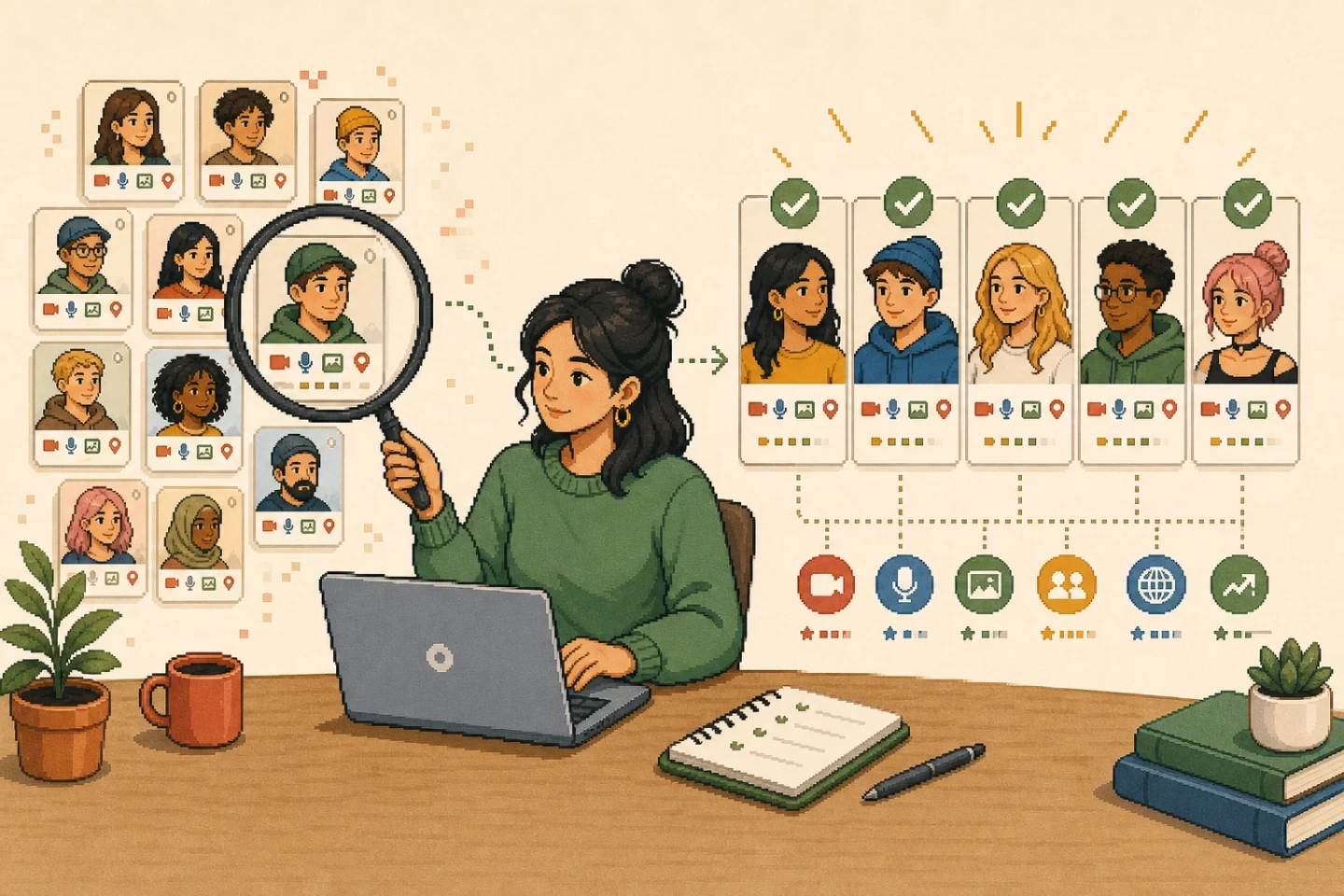
KOL stands for key opinion leader: a person whose recognized expertise and trusted judgment influence decisions within a specific field. Reach can help, but reach alone does not make someone a KOL.
KOL stands for key opinion leader: a person whose recognized expertise and trusted judgment influence decisions within a specific field.
A KOL may be a researcher, practitioner, analyst, educator, reviewer, or creator. Some KOLs have a large social audience. Others influence a smaller professional community through research, technical work, newsletters, talks, or product evaluations. The important point is not fame. It is whether the right people rely on that person's judgment for a specific topic.
What makes someone a KOL?
A job title, follower count, or confident opinion is not enough. A credible KOL usually combines six signals:
Specific expertise. Their authority belongs to a defined field, problem, or audience—not every subject.
Verifiable proof. Their work, research, projects, teaching, reviews, or professional record can be inspected.
Useful judgment. They explain tradeoffs, not just repeat announcements or trends.
Relevant audience trust. People who care about the field return to their work, ask informed questions, and use it in decisions.
Decision influence. Their analysis can change what people test, shortlist, adopt, recommend, or avoid.
Integrity. They separate evidence from opinion, correct errors, and disclose material commercial relationships when relevant.
KOL status is therefore topic-specific. A respected AI researcher may be influential on workplace adoption but not on semiconductor procurement. A trusted developer may shape which open-source tools engineers try without being the right voice for enterprise buying policy.
KOL vs influencer, creator, and thought leader
These labels overlap, but they answer different questions.
Label
Main source of influence
What to verify
KOL
Recognized expertise and trusted judgment in a field
Domain proof, relevance, evidence, and decision influence
Influencer
Ability to shape attention or behavior through an audience
Audience fit, content performance, trust, and campaign history
Creator
Consistent production of useful or entertaining content
Content quality, format fit, reliability, and audience relationship
Thought leader
Distinct ideas that shape how a field discusses a problem
Originality, evidence, adoption of ideas, and track record
One person can fit several labels. A technical educator can be a creator because they publish videos, an influencer because those videos affect tool adoption, and a KOL because practitioners trust their specialist judgment.
The reverse is also possible. A popular lifestyle creator may have strong influence but no demonstrated expertise in AI infrastructure. An experienced researcher may be a KOL inside a professional field with little interest in social-media reach.
AI and technology KOL examples
There is no universal registry that certifies someone as a KOL. The examples below show different evidence patterns you can evaluate. Inclusion is an editorial example, not an endorsement, partnership, or permanent status.
Wharton identifies him as a professor whose work covers innovation and entrepreneurship; his public work translates AI research into practical questions for organizations and educators.
Institutional expertise can combine with accessible interpretation, helping non-specialists make adoption decisions.
Ben's Bites organizes AI learning and tool-oriented material for people trying to understand and apply new products.
A trusted educator or curator may influence workflow adoption even when the value comes from synthesis rather than original model research.
These are deliberately different cases. One has an institutional academic base, one is a hands-on technical practitioner, and two are tool-discovery or education-led publishers. The lesson is not to copy a list of names. It is to identify which evidence pattern your campaign actually needs.
For an AI developer tool, reproducible technical evaluation may matter most. For an AI CMO product, the better fit may be someone who understands marketing operations, can compare tools in realistic workflows, and speaks to the same type of founder or marketer you serve.
A practical KOL evidence card
Use this six-part card before adding someone to a campaign shortlist. This is a Tomako editorial framework, not an industry certification or a mathematical truth.
Check
Evidence to collect
Warning sign
Domain fit
Recent work on the exact topic and problem
Broad popularity with little relevant work
Expertise
Projects, research, professional practice, teaching, or sustained analysis
Authority rests only on a bio or title
Judgment
Clear reasoning, tradeoffs, tests, and corrections
Reposts claims without adding analysis
Audience fit
Relevant people engage, ask informed questions, or reuse the work
Large but unrelated audience
Decision influence
Signs that people test, shortlist, adopt, cite, or avoid based on the work
Attention with no visible connection to decisions
Integrity
Sources, uncertainty, corrections, and commercial disclosure
Hidden incentives or claims stronger than the evidence
Record each check as supported, needs validation, or not supported. Do not convert missing data into a low score. If audience geography or sponsored-post performance is unavailable, mark it unknown and request first-party evidence only when the decision justifies it.
A strong candidate does not need perfect evidence in every cell. But expertise, topic relevance, and integrity should be clear before outreach. Audience and performance gaps can then become specific validation questions rather than assumptions.
What is KOL marketing?
KOL marketing is a brand collaboration with a topic expert whose judgment matters to the target audience. The collaboration might involve an independent review, technical tutorial, research discussion, event, product test, newsletter, webinar, advisory session, or creator-led campaign.
The goal is not to borrow a prestigious name. It is to connect a credible voice with a real audience decision.
For example, an AI productivity product might work with a practitioner who can test the product inside a repeatable workflow, explain who it helps, and point out limitations. That is more useful than asking a generally popular account to repeat feature claims.
A good KOL campaign therefore begins with the decision you want to help the audience make:
Should they understand a new category?
Should they compare two approaches?
Should they test a workflow?
Should they trust a technical claim?
Should they add a product to a shortlist?
The deliverable, channel, and compensation come after that decision is clear.
How to find and evaluate KOLs
1. Define the field narrowly
Replace “AI KOL” with a useful problem statement: “people who help US-based indie founders choose AI coding tools,” or “operators who teach small marketing teams how to evaluate AI automation.” A narrow field improves both search quality and fit.
2. Search where expertise is visible
Look beyond follower databases. Search technical blogs, newsletters, conference programs, open-source projects, podcasts, YouTube, professional communities, research institutions, and product-review archives. Different fields reveal authority in different places.
3. Collect representative work
Save several recent pieces that match your topic. Record URLs, dates, claims, methods, audience questions, sponsored relationships, and any meaningful corrections. One viral post is not a track record.
4. Apply the evidence card
Separate observations from inferences. “Published three hands-on comparisons in the last six months” is an observation. “Their audience will buy our product” is an inference that still needs support.
5. Validate audience and commercial fit
Check language, market, audience role, content format, prior sponsorships, conflicts, and brand-safety concerns. When the campaign risk or spend is material, request first-party evidence for the exact format and market.
Our 15-minute influencer audit shows how to preserve observations, inferences, unknowns, and next checks without making unsupported fraud claims.
6. Start with a bounded collaboration
Use a clear brief, one primary outcome, defined rights, disclosure requirements, and a review process. A small initial project can test working style and audience response before a larger commitment.
Turn that decision into a creator-facing brief with a clear outcome, required facts, creative boundaries, and approval path. When a proposal arrives, use the influencer negotiation guide to separate scope, production, usage rights, and price.
Common KOL mistakes
Treating reach as authority. Reach can distribute an opinion; it does not prove the opinion is useful or trusted on your topic.
Treating credentials as campaign fit. A strong professional record does not guarantee the person reaches your market, uses your format, or wants commercial partnerships.
Choosing the category before the task. “We need a KOL campaign” is not yet a goal. Start with the audience decision and select the collaboration type later.
Using generic name lists. A famous-person list becomes stale quickly and rarely explains why each person fits your product, audience, market, and risk level.
Hiding unknowns inside a score. Missing audience data, unclear sponsorship history, or uncertain contact information should remain visible until checked.
Automating outreach before review. A candidate list is research, not permission to contact everyone. Review fit, source, recipient, message, and campaign terms before any external action.
Where Tomako fits
Tomako is designed to help an AI or SaaS team turn a creator brief into a reviewable KOL candidate workflow. It can use public content to search for relevant creators, preserve source-linked evidence, and show criteria as supported, unmet, or unknown.
The human remains responsible for the shortlist, recipient verification, outreach, commercial terms, and final campaign decision. Tomako does not turn public popularity into a KOL certification, and it should not hide missing evidence behind a confident score.
This workflow also fits a broader AI CMO operating model: software can prepare research and next actions, while people retain direction, approvals, and accountability.
Frequently asked questions
What does KOL stand for?
KOL stands for key opinion leader. The term describes a person whose recognized expertise and trusted judgment influence decisions in a particular field.
Is a KOL the same as an influencer?
Not always. An influencer is usually defined by their ability to affect an audience. A KOL is defined more specifically by domain expertise and trusted judgment. One person can be both.
Does a KOL need a large following?
No. Audience size can help distribute ideas, but a smaller specialist audience may be more valuable when it contains the people who make or shape the target decision.
What are examples of KOLs in AI and technology?
Useful examples include academic interpreters such as Ethan Mollick, technical practitioners such as Simon Willison, and tool-curation or education-led publishers such as Matt Wolfe's Future Tools and Ben Tossell's Ben's Bites. The useful question is not whether a name appears on a list, but which evidence makes that person relevant to your exact topic and audience.
How do you choose a KOL for a campaign?
Define the audience decision first, then review topic fit, verifiable expertise, judgment quality, audience relevance, decision influence, integrity, and commercial conflicts. Keep missing information visible and validate it before material spend or outreach.
Tiny is a co-founder of Tomako, working across the full path from growth strategy to channel execution. His experience spans influencer marketing, affiliate marketing, SEO/GEO, and paid acquisition. As an indie maker and creator, he is especially interested in how small teams can make better growth choices with limited resources. On the Tomako Blog, he writes about channel decisions, practical execution, and lessons from building and growing products.
 Tiny