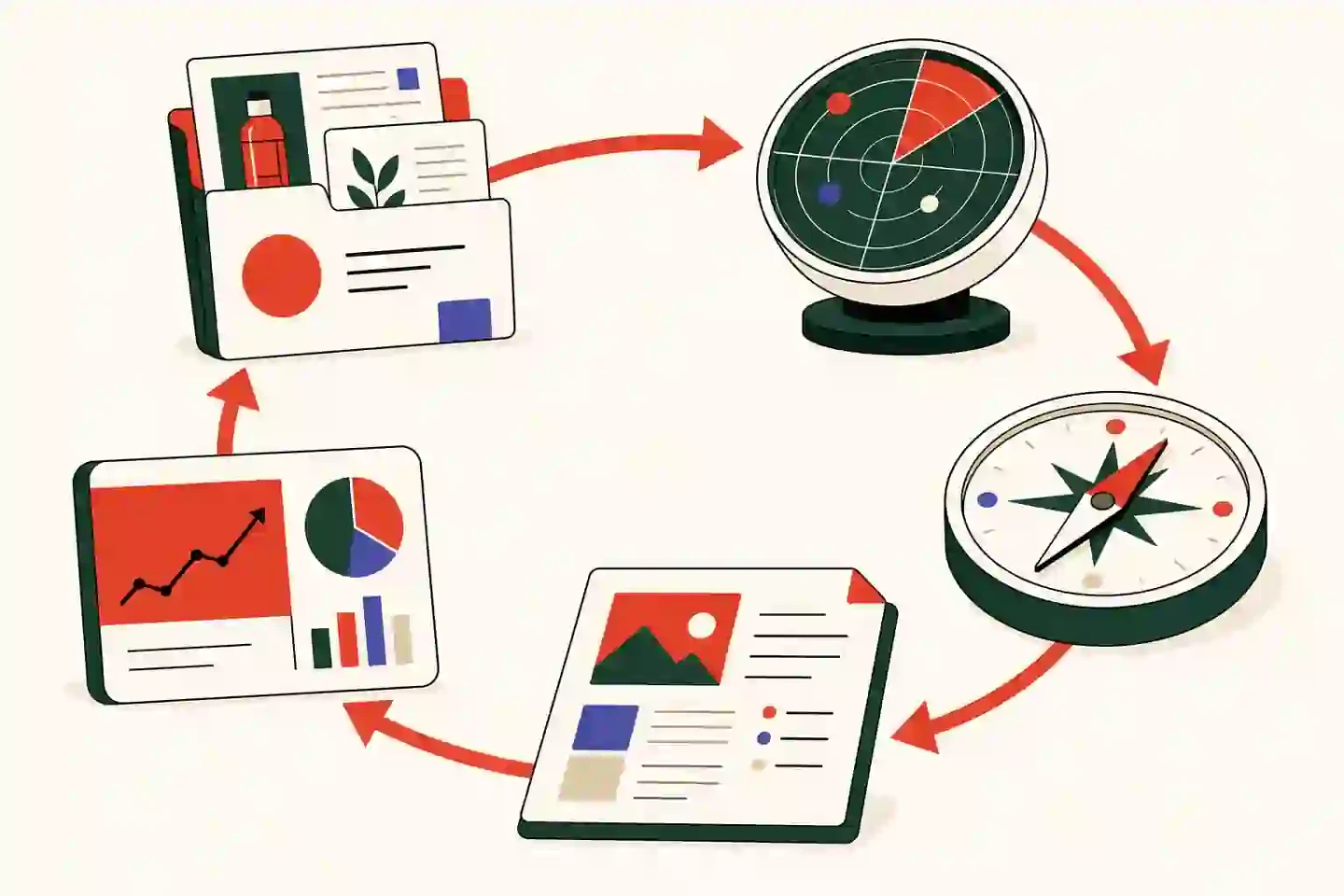
An AI CMO is autonomous software that handles chief marketing officer functions - including content creation, SEO, competitive monitoring, performance reporting, and customer feedback analysis - without requiring a dedicated marketing hire. It works continuously across channels, executing and optimizing marketing on behalf of founders and small teams who cannot staff a full marketing department.
An AI CMO is autonomous software that handles chief marketing officer functions - including content creation, SEO, competitive monitoring, performance reporting, and customer feedback analysis - without requiring a dedicated marketing hire. It works continuously across channels, executing and optimizing marketing on behalf of founders and small teams who cannot staff a full marketing department.
That's the short answer. The longer one matters more, because "AI CMO" is becoming a category loaded with hype and light on specifics. This guide cuts through both. You'll find exactly what tasks an AI CMO handles each day, what it costs compared to the human alternatives, how to know whether your business actually needs one right now, and - just as important - what it genuinely cannot do.
Published by Tomako - an AI CMO platform built for founders and small teams. Last updated: September 2026.
The Honest Definition (Without the Hype)
Before examining what an AI CMO does, it helps to understand what a human CMO actually does - because the AI version only makes sense in that context.
What a Human CMO Actually Does
A Chief Marketing Officer owns the full marketing function of a company. According to the , marketing management roles carry median annual wages above $156,000, and senior CMO compensation at growth-stage companies regularly reaches $250,000 to $400,000 when stock and bonuses are included. For that investment, a CMO sets the go-to-market strategy, builds and leads a marketing team, allocates budget across channels, manages agency and vendor relationships, communicates brand direction to the board and executives, and is personally accountable for revenue growth tied to marketing.
That last part matters. A human CMO is ultimately a leader, a communicator, and a decision-maker who operates inside the politics and culture of the organization. Their value is partly in execution, but significantly in judgment - knowing when to zig when a competitor zags, when a brand needs to evolve, and how to read a room in a board meeting.
What an AI CMO Actually Does
An AI CMO is software built to handle the execution layer of marketing - the recurring, high-volume work that would otherwise require a marketing team of three to five people. This is agentic AI in practice: a system of coordinated AI agents, each specialized in a specific domain (content, SEO, analytics, competitive research), that work together under a shared understanding of your business.
The phrase "execution layer" is deliberate. An AI CMO doesn't set the vision for your brand from scratch. It takes your business context - your product, your audience, your goals, your tone of voice - and runs the marketing operations continuously, surfacing recommendations and completing tasks without waiting to be prompted for each one.
Agentic marketing means AI that acts proactively rather than reactively. A chatbot like ChatGPT waits for your input and produces output. A marketing automation tool sends pre-scheduled emails to a pre-built list. An AI CMO monitors your competitive environment, identifies a content gap in your SEO, drafts and publishes a blog post to fill it, then measures whether organic traffic responded - all without you filing a request.
What an AI CMO Does Not Do (Honest Limits)
Let's be direct about the limits now, not at the end where they're easy to miss.
An AI CMO does not:
Create original brand positioning from a blank page - it builds within the strategic frame you provide
Manage board-level relationships or communicate marketing direction to investors
Exercise cultural or ethical judgment (it requires human guardrails for sensitive content)
Negotiate complex agency contracts or manage legal review
Capture a genuine cultural moment the way a human creative director can
Replace the judgment a seasoned CMO brings to a board conversation about whether to enter a new market
The honest frame is this: an AI CMO is not a replacement for a senior marketing leader. It is a replacement for the 60-80% of marketing work that is operational, repeatable, and data-driven - the kind of work that, for most early-stage companies, simply doesn't get done because there's no one to do it.
Human CMO vs. Fractional CMO vs. AI CMO
Dimension
Full-Time CMO
Fractional CMO
AI CMO
Monthly Cost
$12,500-$33,000+ salary
$5,000-$15,000 retainer
$99-$999/month (platform pricing)
Time to First Output
30-90 days (hiring + ramp)
2-4 weeks
Hours to days
Scope
Full strategy + execution leadership
Strategy + oversight (limited hours)
Execution across all channels, continuously
Human Judgment
High - cultural, political, creative
Moderate - strategic, advisory
Low - operates within set guardrails
Scalability
Limited by headcount and hours
Limited by contracted hours
Scales with business needs
Availability
Business hours
Part-time, scheduled
Always-on, 24/7
Best For
Series B+ companies with marketing teams to lead
Funded startups needing strategic guidance
Pre-revenue to Series A teams without a marketing hire
The 6 Core Functions an AI CMO Handles for Your Business
Here is what an AI CMO actually produces. These are not aspirational capabilities - they are the recurring, concrete tasks that disappear from the founder's plate when a system like this is running.
An AI CMO covers six distinct functional areas: content creation and publishing, SEO and search visibility, competitive intelligence, creator and influencer partnerships, customer feedback and market signals, and performance reporting and budget guidance.
1. Content Creation and Publishing
Content is where most founders feel the gap most acutely. You know you should be publishing - blog posts, email sequences, LinkedIn updates, landing page copy - but between building the product and talking to customers, content falls to the bottom of the list every week.
An AI CMO handles the full content production cycle:
Blog posts and long-form articles are researched, drafted, and formatted for SEO with appropriate internal linking and keyword targeting
Email sequences include welcome series, nurture flows, and re-engagement campaigns, written to match your brand voice and segmented by audience type
Social copy spans platform-adapted posts for LinkedIn, X, and others, scheduled consistently rather than published in bursts when you remember
Landing page copy covers product pages, feature announcements, and campaign-specific pages written to convert a defined ideal customer profile (ICP)
Campaign briefs provide structured briefs for any creative assets that need human or agency production
Brand voice maintenance is one of the subtler capabilities here. An AI CMO trained on your existing content, your product documentation, and your positioning learns to write in your register - not a generic AI tone. The output isn't perfect from day one, but it calibrates quickly as you provide feedback in the first weeks.
An AI CMO produces long-form SEO blog posts, short-form social posts (LinkedIn, X, Threads), email newsletters and drip sequences, product landing page copy, ad copy (search, social, display), campaign briefs for creative teams, press release drafts, case study outlines and interview guides, FAQ content for product pages and help centers, and video script outlines.
2. SEO and Search Visibility
Search engine optimization is not just a content function - it's a continuous research and monitoring operation. An AI CMO treats SEO as an always-on discipline rather than a quarterly project.
Specific tasks include:
Keyword gap analysis identifies queries your ICP is searching that you have no content for
Topical authority mapping builds a content cluster plan around your core product themes so search engines recognize you as a category authority
On-page optimization adjusts title tags, meta descriptions, heading structure, and internal linking on existing pages based on performance data
Technical SEO flags surface crawl issues, page speed problems, and indexation errors that a human would need to audit manually
Generative Engine Optimization (GEO) optimizes content to appear in AI-generated answers from systems like Google's AI Overviews, Perplexity, and ChatGPT search. GEO is the 2026 extension of traditional SEO, and any AI CMO worth the name needs to handle both
The distinction between an AI CMO and a standard SEO tool is that the AI CMO doesn't just surface data - it acts on it. When a keyword gap is identified, it drafts the article. When a page's click-through rate drops, it rewrites the meta description. The loop closes internally, not handed back to a human task list.
3. Competitive Intelligence
This is the function competitors in the AI CMO category most consistently ignore, and it may be the most practically valuable for early-stage founders.
An AI CMO that's doing its job doesn't wait for you to notice that a competitor launched a new feature or shifted their messaging. It monitors continuously and surfaces what matters.
Concrete tasks in this area:
Competitor content tracking monitors when rival brands publish new content, what topics they're covering, and how those topics rank
Share-of-voice measurement tracks how your brand's presence in search and social compares to competitors over time
Messaging shift detection identifies when a competitor changes their homepage positioning, pricing, or ICP language
Market gap identification finds topics and audience segments competitors are not addressing that your brand could own
Here is a real example: a competitor in your space publishes a long-form guide on a topic you've been meaning to write about. Without an AI CMO, you might notice this weeks later - or not at all. With an AI CMO, the system flags it within 24 hours, drafts a counter-angle, and queues the post for your review.
4. Creator and Influencer Partnerships
Creator management is often overlooked in discussions of AI CMO functions, yet for many consumer-facing startups, creator partnerships drive more growth than any paid channel.
An AI CMO handles the top-of-funnel and operational work in creator partnerships:
Creator sourcing identifies relevant creators in your niche based on audience overlap with your ICP, engagement rate, and content fit - not just follower count
Outreach drafts deliver personalized partnership pitches that reflect your brand and the creator's specific content style
Campaign briefs provide structured creative briefs that give creators the context they need to produce content that actually converts
Performance tracking measures referral traffic, conversion rates, and audience overlap from each partnership so you know which creators to reinvest in
The human in the loop owns the relationship. You make the final decision on which creators to work with and you're the one building the personal connection. The AI CMO handles the research, the drafts, and the measurement - which typically consumes 80% of the time investment.
5. Customer Feedback and Market Signals
Marketing that isn't connected to what customers actually say is marketing that drifts. An AI CMO closes this loop by continuously pulling signal from the places customers speak honestly.
This includes:
Review monitoring tracks mentions of your product on G2, Trustpilot, App Store, and relevant community forums, and synthesizes themes into actionable patterns
Support ticket analysis identifies recurring questions, complaints, and feature requests that reveal positioning gaps or product-market fit signals
Social listening tracks brand mentions, competitor mentions, and category-level conversations that indicate how your audience is thinking about the problem you solve
Feedback-to-content pipeline turns recurring customer questions into blog posts, FAQ updates, and landing page copy improvements
The practical outcome is that your marketing stops talking past your customers. When five prospects in the same week ask your support team the same question about pricing, the AI CMO identifies the pattern and suggests updating the pricing page - before that friction costs you another conversion.
6. Performance Reporting and Budget Guidance
A dashboard that shows you metrics is not the same as a system that tells you what to do with them. This distinction is where most marketing tools fall short, and where an AI CMO delivers genuine value.
Performance reporting from an AI CMO includes:
Continuous objective tracking measures content, SEO, email, and social performance against the business goals you defined at setup (e.g., "grow organic traffic by 30% in 90 days")
Actionable recommendations surface specific changes (like "this blog post is ranking 11th for your target keyword - update the introduction and add two more FAQs to push it to page one") rather than raw numbers
Budget reallocation guidance recommends where to shift spend when one channel is outperforming another. CDP.com's definition of agentic marketing maturity describes this as the highest-maturity AI marketing behavior: systems that propose a $15,000 budget shift from underperforming paid social to a high-converting content channel and explain the reasoning
Anomaly flagging alerts you when traffic drops, conversion rates change, or a campaign underperforms so you can investigate before a small problem becomes a large one
What Changes in Your First 30 Days With an AI CMO
This section is deliberately specific, because "you'll see results quickly" is something every software vendor says and almost none quantify.
Week 1 - Setup and Brand Context
The first week is about giving the system enough context to work from. You provide your company website URL and any existing brand documentation, a description of your product and who it's for (your ICP), your top three to five business objectives for the next 90 days, competitors you're aware of, and tone-of-voice guidance or examples of content you admire.
In return, the AI CMO produces its initial research: a competitive landscape summary, an SEO gap report showing topics your ICP searches that you have no content for, and a content calendar draft for the first month. You review and approve.
Week 2-3 - First Outputs and Calibration
The first real content appears. Typically, this means two to four blog posts in draft, an email welcome sequence, and an initial set of social posts. This is your calibration window - the content will be directionally correct but may not yet capture your voice perfectly.
Your job in weeks two and three is to review outputs, flag what doesn't feel right, and provide specific feedback. "This is too formal - we use shorter sentences and don't use corporate language" is more useful than "this doesn't sound like us." The system learns from your corrections.
Simultaneously, the competitive intelligence layer starts running: the AI CMO is already monitoring your competitors and tracking keyword movements.
Week 4 - Continuous Operations Begin
By week four, calibration is largely done. The system is publishing consistently, the SEO work is in motion, and the feedback loop between customer signals and content is live. The founder's weekly time investment at this point is typically one to two hours: reviewing outputs, approving or adjusting strategic pivots, and checking the performance summary.
After 30 days, expect a consistent publishing cadence (something that likely didn't exist before), an SEO content plan covering 20-40 keyword targets, three to five pieces of published content starting to index, a competitive intelligence log showing what competitors have been doing, and at least one customer feedback insight that has influenced messaging.
What you should not expect after 30 days: a significant jump in organic traffic (SEO takes three to six months to show measurable results), a flood of inbound leads from content alone, or perfect brand voice reproduction without any feedback or correction.
This is an honest 30-day picture. The system starts working immediately. The compounding effects take time.
Here is a resource that addresses the broader question of whether AI agents can genuinely replace marketing functions - and gives an honest answer:
The cost question is the one founders care most about, and honest numbers rarely appear in competing articles. Here they are.
Full-Time CMO Hire
A full-time CMO at a venture-backed startup typically earns a base salary between $180,000 and $350,000, plus equity and benefits. Even at the low end, total compensation exceeds $200,000 annually when benefits and employer taxes are included. Recruiting and onboarding add another $20,000-$50,000 in time and fees. Time to impact is typically 60-90 days as the new hire learns the business.
This option makes sense when you have a marketing team to lead, a clear go-to-market strategy that needs executive ownership, and sufficient revenue to justify the investment.
Fractional CMO
A fractional CMO is a senior marketing executive who works with your company on a part-time retainer - typically 10-20 hours per week. Retainer costs range from $5,000 to $15,000 per month, which translates to $60,000-$180,000 per year. The advantage is strategic expertise without full-time commitment. The limitation is hours: a fractional CMO advises and directs but rarely executes, meaning you still need someone to do the actual marketing work.
Marketing Agency
A full-service marketing agency manages campaigns, content, and media buying on your behalf. Monthly retainers for agencies working with early-stage companies typically run $3,000-$20,000, depending on scope. Agencies are excellent for specific campaign execution but often slow to adapt, and their work rarely compounds the way owned content does.
AI CMO Platform
AI CMO platforms like Tomako start at under $100 per month and scale to $500-$1,000 per month for growing teams. The entire annual cost fits within a single month of fractional CMO retainer at the high end.
Full-Time CMO
Fractional CMO
Marketing Agency
AI CMO (e.g., Tomako)
Annual Cost
$200,000-$400,000+
$60,000-$180,000
$36,000-$240,000
$1,200-$12,000
Time to First Output
60-90 days
2-4 weeks
2-4 weeks
Hours to days
Execution
Delegates to team
Advises, rarely executes
Executes specific campaigns
Executes continuously across all channels
Hours Available
~2,000/year
500-1,000/year
Varies by retainer
Always-on, unlimited
Human Judgment
High
High (strategic)
Moderate
Low (within guardrails)
Content Production
Manages it
Oversees it
Produces to brief
Produces continuously
SEO / Competitive Intel
Owns strategy
Advises
Often siloed
Integrated and continuous
Best For
Series B+ with marketing team
Seed to Series A needing strategy
Specific campaign needs
Pre-revenue to Series A, no marketing hire
The cost difference is stark. A founder choosing between a fractional CMO at $8,000/month and an AI CMO at $299/month is looking at a $93,000 annual difference. The fractional CMO brings human judgment and strategic depth the AI CMO cannot replicate. The AI CMO brings 24/7 execution, content production, and competitive monitoring the fractional CMO doesn't have time to do. For many early-stage teams, the right answer is the AI CMO now, and a fractional or full-time CMO later - when there's enough revenue to justify it and enough output from the AI CMO to hand off.
McKinsey's Global Institute analysis found that generative AI could automate 60-70% of the time employees currently spend on marketing and sales activities, which aligns with the operational-versus-strategic split described here.
Is an AI CMO Right for Your Business Right Now?
The honest answer is: it depends on where you are. Here is a decision framework built from the questions that actually matter.
Signs an AI CMO Is a Strong Fit
You're likely a strong candidate if you have no dedicated marketing hire and no immediate budget for one, you know who your customer is but marketing is the last thing you get to each week, your product has some validation (even pre-revenue, you should have a defined ICP), you can set aside one to two hours per week to review outputs and provide strategic direction, you want marketing to start producing results now rather than after a three-month hiring process, and you're building in a category where content and SEO compound over time (SaaS, services, media).
Signs You Should Wait or Hire a Human First
An AI CMO may not be the right first move if you haven't yet validated your product - marketing spend before product-market fit is usually wasted regardless of who (or what) does it, your business depends primarily on personal relationships and offline sales (the AI CMO's strengths are digital), you have no strategic frame at all - you don't know your audience, your positioning, or your goals (an AI CMO needs direction to execute from), or you're in a highly regulated industry (legal, medical, financial services) where compliance review is required on every content piece - the AI CMO can draft, but a human must review every output before publication.
Do You Need an AI CMO Right Now? A 7-Question Check
Work through these honestly:
Do you have a dedicated marketing hire? If yes, you probably need strategy support, not execution automation. If no, keep going.
Is your product validated with at least some paying customers or strong signal of demand? If no, focus on product first. If yes, keep going.
Can you articulate who your ideal customer is and what problem you solve for them? If no, spend a week on positioning first. If yes, keep going.
Do you have $200-$500/month available for marketing tools? If no, you're not ready for any paid marketing investment. If yes, keep going.
Can you commit one to two hours per week to reviewing marketing outputs? If no, even an AI CMO needs a human in the loop - if you truly have zero time, results will be limited. If yes, keep going.
Do you need marketing to start producing immediately, rather than waiting months for a hire? If yes, an AI CMO is the fastest path to output. If no and you have budget to hire well, a human may serve you better.
Is your marketing currently producing nothing - no consistent content, no SEO presence, no email cadence? If yes, an AI CMO fills a real gap. If you already have a functioning marketing operation, evaluate whether you need execution support or strategic guidance.
Result: If you answered "yes" to questions 2, 3, 4, 5, and 6, and "no" to question 1, an AI CMO is likely the right call for where you are right now.
What an AI CMO Cannot Replace (The Honest Limits)
Trust is built by telling the truth about limitations, not by pretending they don't exist. Here is a clear-eyed accounting of what an AI CMO should not be expected to do.
Brand vision and original positioning strategy. An AI CMO can execute within a strategic frame, but it cannot construct that frame from nothing. The question "who are we, and why does our brand exist?" requires human judgment and often requires talking to customers, which brings us to the next point.
Deep customer relationship insight. The AI CMO can analyze customer reviews and support tickets. It cannot attend a customer dinner, read body language in a sales call, or build the kind of longitudinal relationship with a buyer that reveals what they're really afraid of.
Board-level stakeholder management. A CMO presents to the board, defends budget, and navigates organizational politics. An AI CMO produces the data and the analysis but has no role in that room.
Cultural and ethical judgment. Knowing when a piece of content might land wrong in a particular cultural context - timing an ad launch after a news event, for example - requires human awareness. AI systems can be given guardrails (specific instructions about what not to do), but guardrails are only as good as what a human thought to specify in advance.
Genuine creative risk-taking. The best marketing campaigns are often the ones that break the pattern - a campaign direction no one expected, a format the category hadn't tried. AI CMOs are strong at finding the center of what already works. They are weak at the creative leap that redefines the category.
Legal and compliance review. In regulated industries, every content piece needs human sign-off. An AI CMO can draft with compliance guidance embedded, but it cannot replace a compliance review.
The frame that holds all of this together: The AI CMO executes within the strategy you set. It doesn't set the strategy from nothing, and it doesn't replace the judgment that comes from understanding your business, your market, and your customers at a human level. What it does is make sure that strategy is running, every day, without requiring you to hire a team to execute it.
How Tomako Works as Your Always-On AI CMO
Most AI CMO tools require you to orchestrate the agents yourself - connecting tools, managing prompts, and building workflows. Tomako is built to eliminate that overhead. It functions as a pre-configured AI CMO system that a non-technical founder can operate from week one.
What Tomako Understands About Your Business
When you set up Tomako, you give it the context it needs to operate with specificity: your product, your ICP, your positioning, your competitive landscape, your brand voice, and your goals. Tomako doesn't work from a generic marketing template - it builds a working model of your business that informs every piece of content it produces and every decision it surfaces.
What Tomako Runs Without You
Once configured, Tomako runs the marketing execution layer continuously: publishing content on your approved calendar, monitoring your competitive environment and flagging meaningful changes, tracking keyword rankings and surfacing SEO opportunities, identifying creator and influencer partners relevant to your niche, synthesizing customer feedback into positioning and content recommendations, and reporting on performance against your stated objectives with specific recommended next actions.
This is what "always-on" means in practice. It doesn't mean the system occasionally runs when you log in. It means marketing is operating between your sprints, after hours, over weekends - and you're seeing the output and the recommendations when you sit down for your weekly review.
What You Still Control
You own the strategy. You approve the direction before it ships. You decide which creator partnerships to pursue and which content angles to greenlight. The human-in-the-loop model means Tomako surfaces the work and you steer the ship - the execution doesn't require your time, but the judgment is always yours.
An AI CMO is an autonomous software system that performs chief marketing officer functions - content creation, SEO, competitive monitoring, performance reporting - without requiring a human marketing hire. It uses a system of coordinated AI agents (multi-agent orchestration) to run marketing operations continuously across channels.
Can an AI CMO replace a human CMO?
No, not fully. An AI CMO replaces the operational and execution portions of the CMO role - content production, SEO, competitive tracking, and reporting. It does not replace the strategic leadership, board communication, cultural judgment, or stakeholder management that a senior human CMO provides. For companies at Series B and beyond with marketing teams to lead, a human CMO is essential. For early-stage companies with no marketing function at all, an AI CMO fills a gap that would otherwise go unfilled.
Does AI marketing actually work?
Yes, with realistic expectations. Content and SEO produced by an AI CMO compounds over time - it takes three to six months for organic search content to show meaningful traffic impact. Email sequences, social consistency, and competitive intelligence show faster returns. McKinsey's analysis found that generative AI can automate 60-70% of marketing and sales tasks, which translates to real productivity gains for teams that don't currently have a marketing function at all.
What can an AI CMO agent do for my business?
An AI CMO handles content creation and publishing, SEO and search visibility, competitive intelligence, creator and influencer partnership support, customer feedback synthesis, and performance reporting with budget guidance. It runs these six functions continuously, surfacing recommendations and producing outputs without waiting for you to initiate each task.
How much does an AI CMO cost compared to hiring a CMO?
A full-time CMO costs $200,000-$400,000 annually in total compensation. A fractional CMO retainer runs $60,000-$180,000 per year. A marketing agency costs $36,000-$240,000 per year depending on scope. An AI CMO platform like Tomako runs $1,200-$12,000 annually. The cost difference is 10x to 100x, with the tradeoff being human strategic judgment, which the AI CMO does not provide.
What's the difference between an AI CMO and a marketing automation tool?
Marketing automation tools (like email platforms or social schedulers) execute tasks you set up in advance. They send the email you wrote, schedule the post you created, and report on the campaign you designed. An AI CMO is proactive - it identifies what marketing needs to happen, creates the content, executes it, monitors the results, and recommends adjustments. The difference is the shift from reactive execution to autonomous operation.
Is an AI CMO right for a pre-revenue startup?
It depends. If you have a defined ICP, a clear product hypothesis, and at least some evidence of demand, an AI CMO can start building your content and SEO foundation immediately - which compounds over time. If you haven't validated the product at all, marketing investment (of any kind) typically comes too early. The decision checklist in this article provides a more structured way to assess your specific situation.
What information does an AI CMO need to get started?
At minimum: your website URL, a description of your product and who it's for, your top business objectives for the next 90 days, your known competitors, and any existing brand documentation or tone-of-voice guidelines. The more context you provide, the faster the output calibrates to your business.
How long does it take to see results from an AI CMO?
First content outputs appear in the first one to two weeks. Email sequences and social content show engagement impact within days of going live. SEO content typically takes three to six months to generate measurable organic traffic. Competitive intelligence is live from week one. The compound effect of all channels working together builds significantly over six to twelve months.
What does Tomako do as an AI CMO?
Tomako is an always-on AI CMO platform built for founders and small teams. It takes your business context, runs a six-function marketing operation (content, SEO, competitive intelligence, creator partnerships, customer feedback synthesis, and performance reporting), and delivers a continuous stream of marketing output and recommendations - without requiring you to hire a marketing team. You review, you steer, and Tomako executes.
Key AI CMO Terms, Defined
Agentic marketing - marketing operations run by AI agents that act autonomously on defined objectives, rather than waiting for human prompts for each individual task.
Multi-agent orchestration - a system architecture where multiple specialized AI agents (e.g., a content agent, an SEO agent, an analytics agent) coordinate with each other under a shared understanding of business goals, rather than operating as isolated tools.
Execution layer - the operational work of marketing: content production, publishing, monitoring, reporting. Distinct from the strategy layer, which defines direction, goals, and positioning.
Human-in-the-loop - a model where AI systems produce outputs and recommendations, but a human reviews and approves before final deployment. Essential for brand voice accuracy and compliance.
Guardrails - constraints built into an AI system to prevent outputs that fall outside defined boundaries - for example, "never publish a content piece without human review" or "never make claims about competitors without citing a source."
GEO (Generative Engine Optimization) - the practice of optimizing content to appear in AI-generated answers from systems like Google's AI Overviews, Perplexity, and ChatGPT search, as distinct from traditional SEO targeting blue-link rankings.
ICP (Ideal Customer Profile) - a detailed description of the specific type of customer who gets the most value from your product and is most likely to buy. An AI CMO uses the ICP to calibrate every content and targeting decision.
Tomako is an always-on AI CMO for software growth. It builds a working understanding of a product, brand, business goals, budget, and market, then turns opportunities across content, creators, search, customer feedback, and competitive intelligence into growth work a team can review and move forward. Tomako supports the work without taking over the decisions: direction, brand judgment, spending, publishing, outreach, and accountability remain with the people behind the product.
 Tomako AI