How can free trials and referral rewards bring in users who stay?
People claim free credits fast. Referral links bring in signups, and AI use rises too. Yet after the trial, the number who stay or pay does not rise in step.
Teams can draw opposite conclusions. Some want tighter checks and fewer credits. Others think users need more time to see value, so they want to give away more.
Either choice might help. Either might waste money. A user who does not pay may have claimed credits more than once or joined only for a reward. They may have failed to finish a real task. Or they may simply not need the tool again yet.
Claiming credits or completing one action does not mean someone will keep using or paying for a product. To judge growth, ask why people came, why they would return, and whether the offer brought in more revenue.
People who come for the reward can follow every rule
Comet is an AI browser from Perplexity. One version of its 2025 US referral terms offered $15 to both people in a referral. The new user had to follow a link, download the browser, sign in, and run at least one query. The program banned self-referrals, fake accounts, and bots.
Those checks answer different questions. Is this person eligible for a reward? Did they complete the required action?
A real new user can make a query, collect the reward, and never use the browser again. Their account and participation are real. But will they open it next time they need to find information? The team does not yet know.
Someone may even treat this as a small paid task. A public recruitment post from that period offered another $5 to join through a referral. When money is the reason to join, teams need to separate two groups. Who finished the reward steps? Who later used the product to solve their own problem?
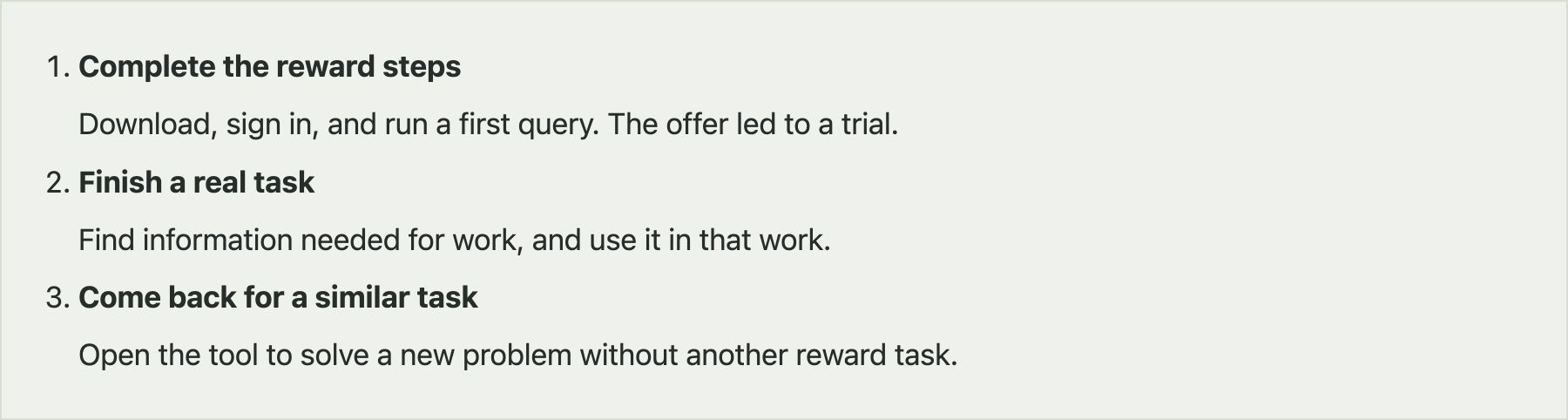
A reward for the first query can help people try an unfamiliar product. After paying it, check whether they used the tool for their own work and would use it again. Coming back for their own task after the reward is gone is a stronger sign that the product is useful.
A delay before paying the reward does not replace that check. The Comet program ended on November 6, 2025. Its help center says pending payouts go through a standard 30-day quality review. Waiting 30 days for a payout does not mean someone used the product throughout that time.
Consider an AI website builder. It could test paying part of a referral reward after someone finishes a usable site, rather than after the first page generation.
But people could still make a throwaway site just to claim it. Check whether they keep editing, use the site, or return for a new project. Adding more steps can make a reward harder to claim without giving people a reason to stay.
Before cutting free credits, check whether users finished their task
Trying an AI tool often means changing a prompt, waiting, finding a problem, and trying again. Heavy use may mean the product is popular. It may also mean the output keeps failing to meet users’ needs. Credit use alone cannot tell you which.
Lovable lets people build websites and apps using plain language. In a Stripe interview, its growth leader described free use as an investment in attracting users. People need to try the tool to learn what it can do for them. She also said users often build in bursts and want to buy extra credits when needed.
That gives us another reason why someone may not return every day. A person might finish an event website in a few days, then have no changes for two weeks. They may have done exactly what they needed.
Another person might generate and rework pages daily but never get a usable result. That user may be further from paying.
If you only count daily users and generated pages, repeated failed attempts may look like success. You may overlook the person who finished a site.
Separate users who got a usable result from those who ran out of credits with work left unfinished. If many are stuck, an extra identity check will not improve the output. Cutting credits may also leave them unable to fix it.
Check the guidance, the reliability of the output, and whether the trial gives suitable new users enough room to finish a task.
Free credits should give new users a fair chance to finish something and judge whether the tool is worth buying. If more credits only lead to more failed attempts, improve the results first.
How often people return depends on the task. Someone who handles documents daily will use a tool more often than someone who builds an occasional website.
Act when repeated credit claims start to hurt normal use
If repeated claims already disrupt other users, you cannot wait to see whether those people return. In 2023, the image tool Midjourney paused free trials. Its founder said large numbers of temporary accounts, combined with a GPU shortage, were affecting paying users.
The cost was already falling on the existing service. Extra free image requests used computing power, while paying users had a worse experience. More signups did not justify giving away still more credits.
In this case, limits on repeated claims and unusually large use serve a clear purpose. To judge them, look beyond the drop in free use. Did normal new users find it harder to start? Did paying users spend less time waiting? Counting blocked accounts alone can hide the people wrongly turned away.
Trials can also differ by channel. Midjourney’s current trial guide says there is no free trial on its website or Discord. The niji journey mobile app offers a limited trial.
Other teams could test a trial in a channel where use is easier to control. Check whether normal new users can complete their first task before expanding it.
If people pay, did the campaign actually add revenue?
Even if the users are new and some buy, you still need to know how much extra revenue the campaign brought in.
Suppose an existing user planned to buy more credits. A referral reward lets them delay that purchase, while their friend places a new order. Counting only the friend’s order misses the purchase the first user did not make. Then subtract the rewards and extra service costs to judge whether the referral was worthwhile.
In one referral program announcement, Lovable limited referrals to paid accounts. Both people received 10 credits, and the post warned against repeated self-referrals. Credits are useful to someone who wants to keep building. But they may replace credits that person would otherwise buy. Reward design needs to account for that risk.
This risk has been observed elsewhere. A randomized field study examined an online dating platform with free and paid features. Adding a referral program brought more referrals but could reduce revenue. Keeping some premium features available only through payment could avoid that loss.
AI tools have different costs and use patterns. Still, the study raises a clear question: are rewards replacing something users would have paid for? Counting only new referred users misses changes in the people inviting them.
There is another case to watch. Someone may already plan to sign up, then look for a reward link. The campaign gets credit for that signup, even though it may not have caused it.
Before raising the referral budget, run a small test. Randomly split similar users from the same period into two groups. Show the offer to one group and leave the other group’s experience unchanged. Then compare later use and revenue. Do not select only the users who successfully invited friends.
Allow enough time for people to need the product again. Include both the people sending invites and the new users they bring in. Subtract rewards and extra service costs. Simply comparing referral-link users with users who arrived on their own can be misleading. The groups may have differed before the campaign.
If the test adds only reward claims, check what the reward asks people to do. If real users cannot finish a task, address what blocks them. If repeated claims hurt the service, limit them first. More completed tasks, return visits, and extra revenue after costs give you a reason to invest more.
You do not need to change every rule at once. Choose the clearest problem, change one thing, and compare it with the old approach. Did free credits help users finish a task? Did referral rewards bring people who wanted to stay? Did added revenue cover the costs? Use those results to decide what to keep or change.