How a paid leaderboard drew 6.28 million views: Outbid’s rise and what came next
A website offered little beyond a chance to pay to rank above other people. At launch, $2 could take first place. The next day, someone paid $10,000 for it. Other companies soon raised their bids, posted their purchases, issued challenges, and asked in public: was it worth the money?
This was Outbid. German developer Jonathan Wilke launched it on X on the evening of August 19, 2026. He reported more than 200,000 visitors and $21,499 in revenue on day one. About 36 hours in, he reported $42,000 in revenue.
By September 9, the launch post had about 6.28 million views, 1,234 quote posts, and 113 plain reposts.
Advertisers paid the site and helped bring it an audience. Some used their rank to promote a software business. Some made the purchase a public experiment. Others quickly copied the whole site but could not find a first real buyer.
The leaderboard alone does not explain the rise. Jonathan’s earlier work, buyers’ reasons to join, and the path from attention to sales all mattered. The same rules that drove growth also created barriers.
Where did Jonathan’s first audience come from?
Jonathan’s earlier business was supastarter. It sells code templates for the basic features developers often rebuild when making subscription software. He and a friend kept doing that work for clients. They first made a reusable version, then began selling it.
In a 2025 Indie Hackers interview, he said it had more than 800 customers and averaged about $12,000 in monthly revenue. Sharing progress and gathering feedback on X were key parts of his active marketing.
In the comments, he added that building in public had brought him about 8,000 followers. X was one of supastarter’s top three traffic sources.
In a later High Signal interview, Jonathan recalled having about 11,000 followers before Outbid launched. Their interests mattered as much as their number. He talked about building products, so some of his audience also needed ways to find customers. When he launched a paid promotion tool, potential buyers were already listening.
He brought three things to the new project:
- A way to reach people. Existing followers gave the launch its first audience.
- Familiarity built through his work. People had watched him run supastarter and had a reason to be curious about his next experiment.
- An understanding of the audience. They liked watching people build things and needed ways to promote their own products.
Together, these gave the first clicks a chance to become the first payments.
Outbid also brought customers to supastarter. Its page kept a link to the main product, which held first place at the start. People following the experiment could discover it. Jonathan later said supastarter sold more licenses than usual.
The event brought him leaderboard revenue, personal attention, and new contact with potential customers for his main business.
For someone running related products, a new project can attract people whose needs overlap with the main business. Even a short burst of interest may leave useful relationships. The project still needs its own appeal, and the main product must fit naturally. A footer link alone will not create that result.
Enter a URL, pay, and put your product on the board
Outbid drew inspiration from TrustMRR, a leaderboard that displays business revenue. Jonathan did not want users to submit API keys for their payment services. He chose a simpler ranking rule: pay more, rank higher. He had expected the small experiment to make only a few hundred dollars.
The launch copy spoke to a daily founder task: promoting a product. It framed taking first place as a quick way to finish that day’s marketing. Trying it required just a URL and a payment.
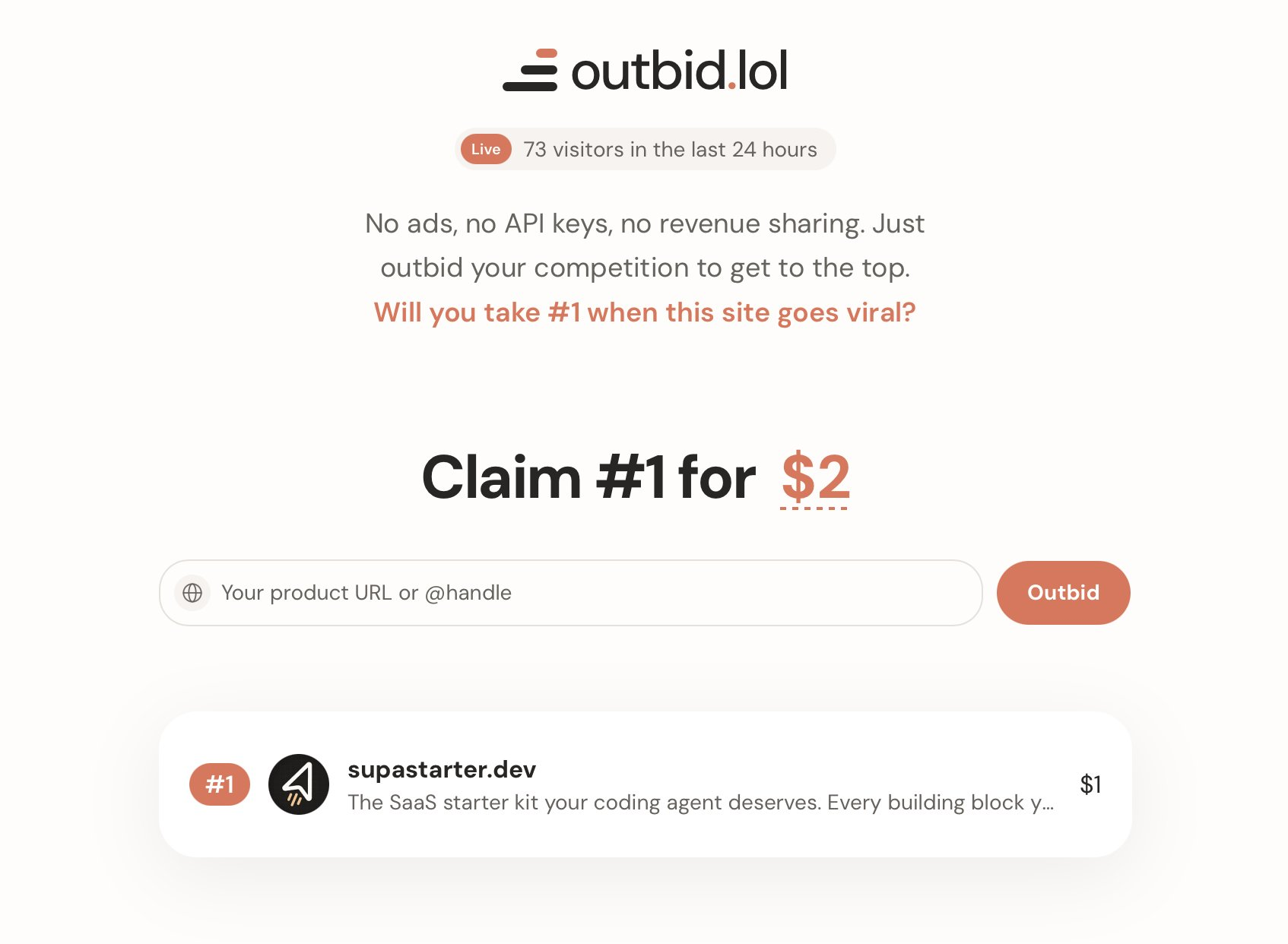
One screen showed how to join and what the payment bought:
Enter a URL, choose an amount, and pay. No launch package to prepare first.
The product appears on the board. Its position changes with the amount paid.
The leader and the price to take first appear together, so visitors can judge the cost.
Early buyers took a chance. Traffic was small, but a cheap position might gain more views if the site spread. The low starting price made a test affordable. Jonathan’s existing audience gave some reason to expect later visitors.
Before launch, he shared hosting progress, a countdown, and payment preparations. Later posts quoted earlier ones. Followers could watch the project move from development to release. By launch, it already had a story they could follow.
Jonathan introduced the project to his followers.
Jack shared results. Jonathan reported $21,499 in day-one revenue. Lewis then paid $10,000 to take first.
CrowdReply invited others to take its lead, then shared signups and demo bookings two days later.
Alex interviewed Jonathan about the launch, buyer feedback, and what came next.
From $420 to $10,000, buyers made their purchases public
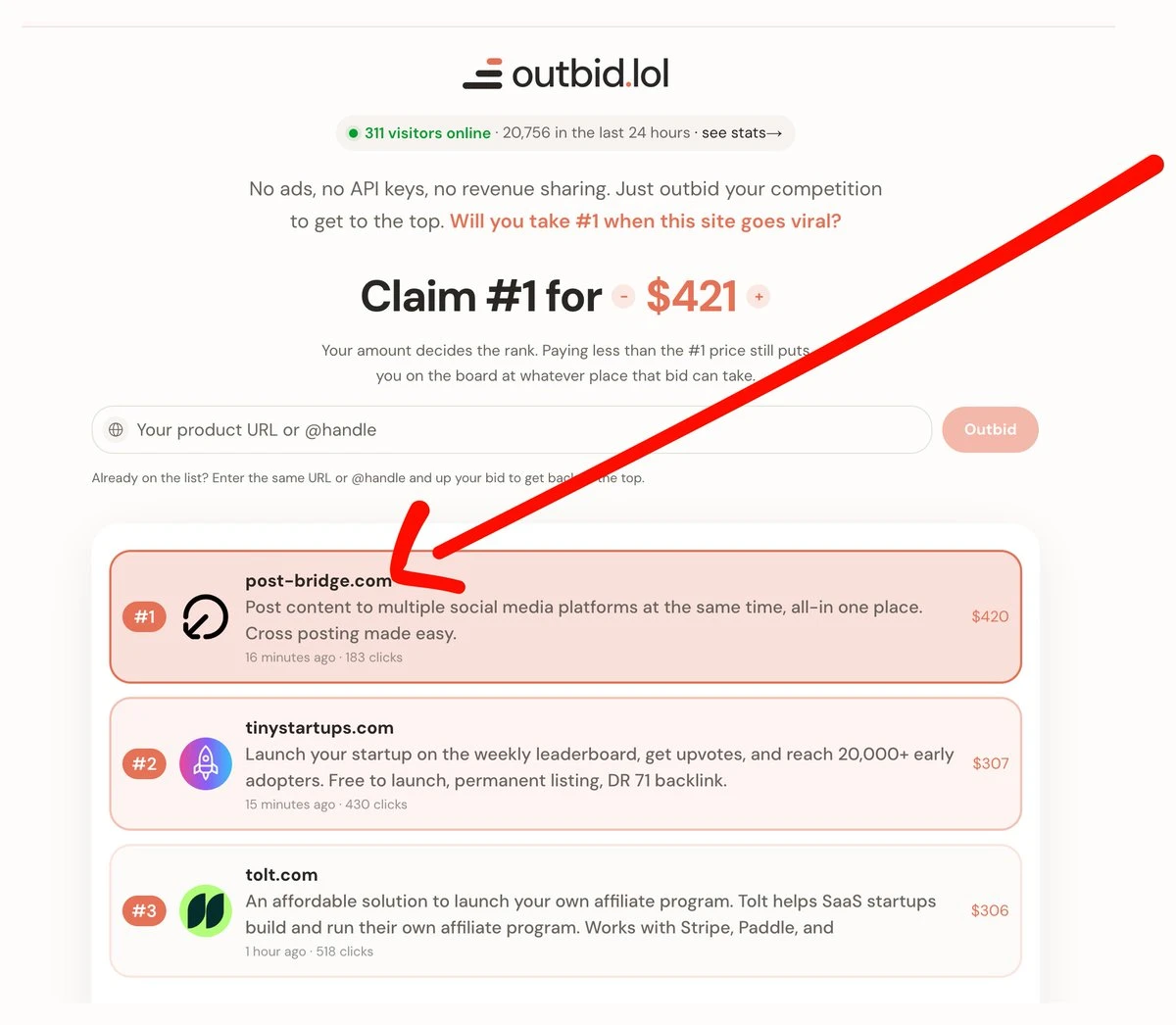
On August 20, Jack Friks posted his $420 first-place purchase and early clicks. He said it brought more than 150 clicks in 15 minutes, with about 300 people online. Readers saw the price, time, and response, as well as a link to a new site.
Later that day, Lewis from Comp AI quoted Jack’s post and announced a $10,000 payment for first place. He said he would see whether it paid off. The familiar format and sharp price jump let him move the story forward without explaining the product from scratch.
$420, with early results
$10,000, with returns still to come
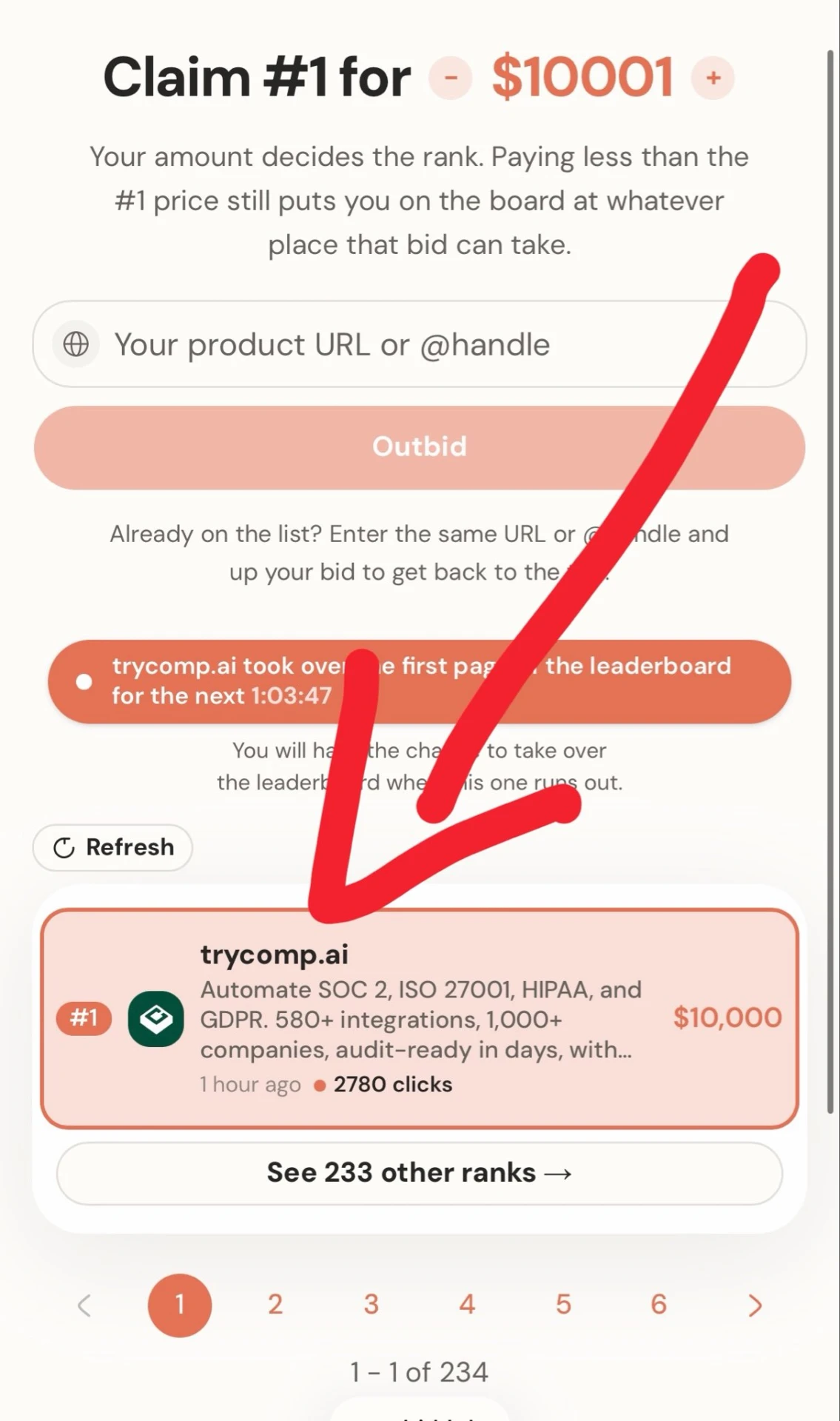
One post gave early results. The next raised the stakes to $10,000. By September 9, each had about 160,000 views. Buyers’ own posts drew attention too.
The paid position became material for a buyer’s social account: introduce the product, explain the choice, and invite people to follow the result. One payment bought exposure on the site and a chance to join a popular story. The second benefit depended on how buyers told that story and whether their audience responded.
On August 21, CrowdReply invited others to take first place. It showed a leading payment of $12,521, just above a rival’s $12,516. The $5 gap made the contest feel active. The next buyer had a clear challenge to answer.
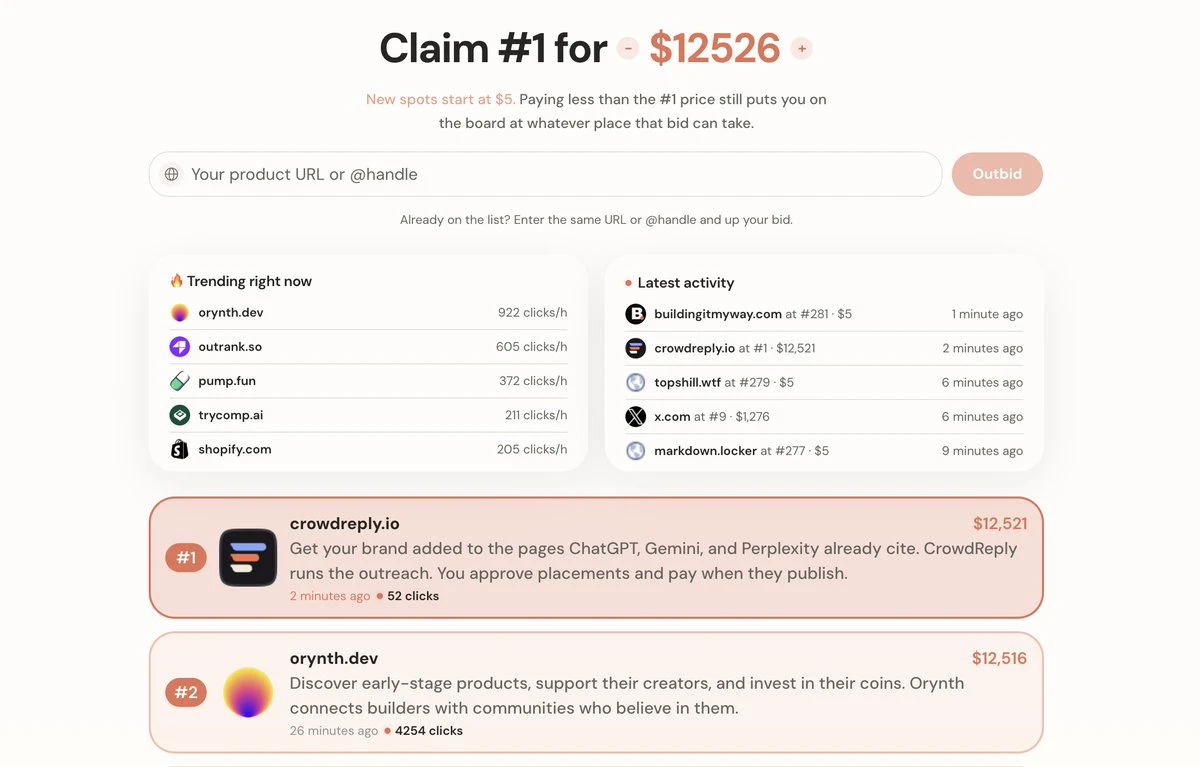
Its first-place post drew about 259,000 views. Two days later, it quoted the purchase post and shared results. That follow-up drew about 82,000 views. One purchase gave the company two moments to speak: the decision and the outcome.
The launch post showed a similar pattern. By September 9, it had about 1,234 quotes and just 113 plain reposts. A quote lets someone keep the original post and add a view, a purchase result, or a doubt.
Outbid gave people room to explain what the story meant to them. Not all quotes were supportive. But the discussion could keep going without Jonathan repeating the same pitch.
His own reports also added new developments. The day-one update covered visitors, revenue, followers, an analytics outage, an offer to buy the site, and copies. About 36 hours in, he reported roughly 1.06 million visitors, $42,000 in revenue, and at least 10 copies.
The $100,000 acquisition offer was only an offer. Even so, it gave people something new to discuss.
These figures and surprises turned a bidding contest into an ongoing story about what might happen next. Repeated totals alone would soon get dull. New people, problems, and results gave the audience reasons to return.
Can a five-figure leaderboard purchase pay off?
A five-figure payment for a rank can look like showing off. Buyers later explained another reason: some had high customer values. A few suitable customers might make the test worthwhile.
Lewis later said Comp AI had historically closed about 30% of demos, with an average of 14 days from demo to sale. Expected lifetime value could exceed $40,000 per customer. That explains why it might risk $10,000: a small number of customers could cover the outlay.
Two days after inviting rivals to take its lead, CrowdReply reported its progress:
- About $12,700 spent and more than 6,550 clicks.
- 1,800 signups and over 50 demo bookings, plus more than 500 new followers.
- Potential deals in its sales pipeline totaling about $50,000 a month.
Comp AI explained its willingness to spend. CrowdReply showed attention moving toward signups and sales calls.
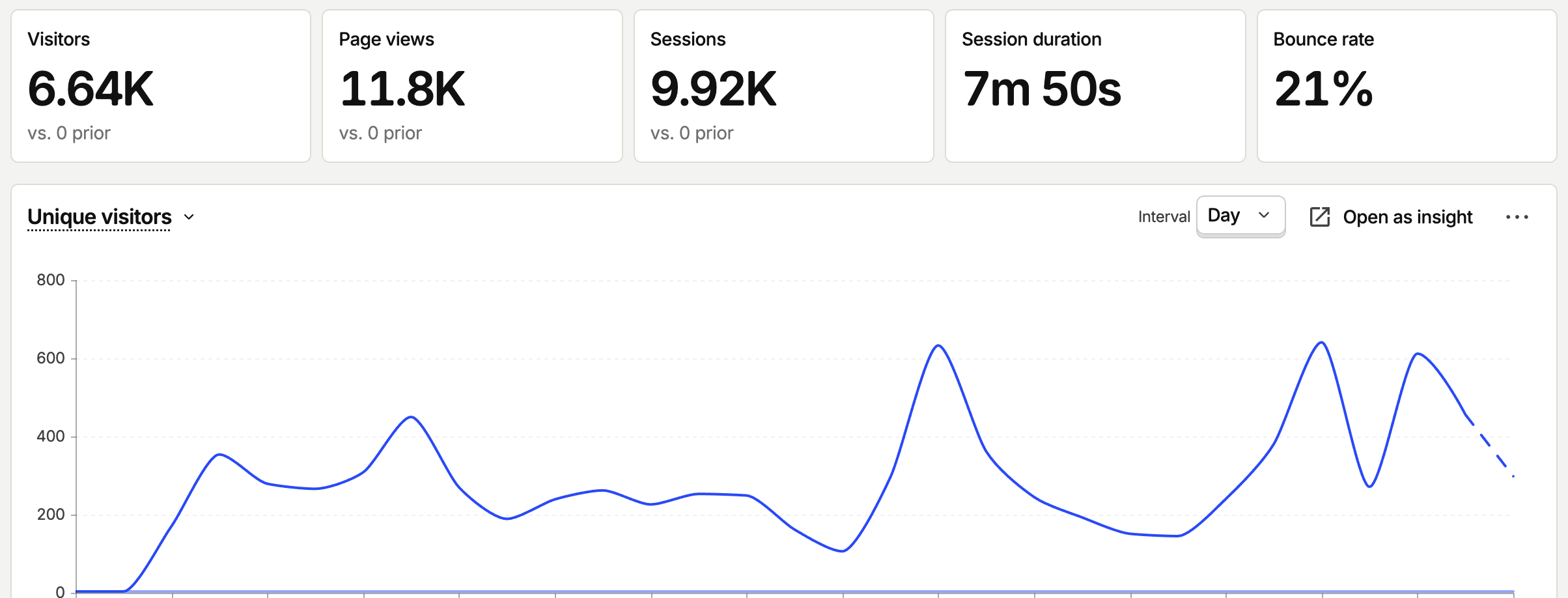
Using CrowdReply’s figures, the cost was about $7.06 per signup and no more than roughly $254 per demo booking. A demo gives a sales team a chance to close a high-value business customer. A low-price product may struggle with the same costs. Value depends on customer value and later sales.
Tibo’s estimate for Outrank was more direct. He spent $12,000 on Outbid and also bought positions on several copies. Trials in the next three days were 44, 38, and 31, against a usual level of about 20 a day.
He estimated 53 extra trials. At about $2,000 in lifetime value per customer, six of them staying could cover the Outbid payment.
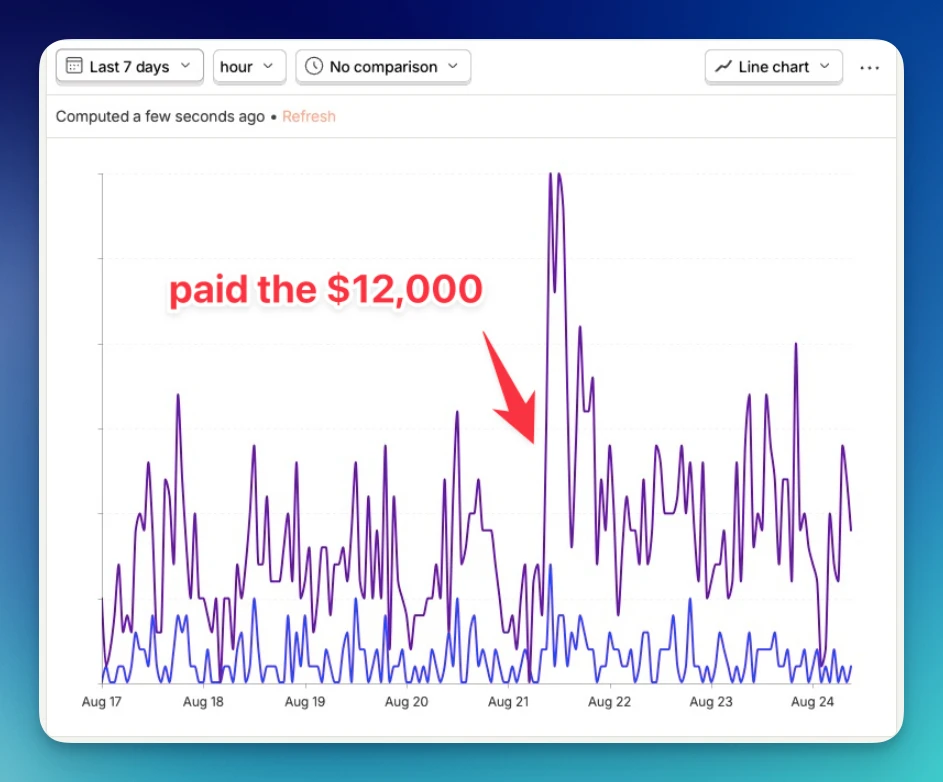
He gave the test a clear target: retain six customers from 53 estimated extra trials. That could guide follow-up, help with first use, and tracking payment. It was more useful than a general claim that paid rankings work.
MakerThrive’s report was more striking. It claimed $42 in spending, 64,000 visitors, and $29,000 in revenue that day. How much revenue came from the purchase was unclear.
Still, a story about reaching tens of thousands for $42 could make another founder curious. Large bids created suspense. Small-budget success stories made joining seem possible.
| Who is involved? | Visible early gains | What to track next |
|---|---|---|
| Outbid’s operator | Payments, visits, and followers | New and repeat payments, operating costs, and revenue after interest falls |
| Companies buying a place | Clicks, purchase-post views, signups, and bookings | Suitable customers, gross profit, and cash received; separate site and social traffic |
| Jonathan’s main product | People discovering supastarter | Whether they become template customers, followers, or a lasting audience |
Buyer stories later appeared on Outbid’s About page. New visitors could see why companies bought and what happened afterward. The site went beyond explaining the rules. Participants helped answer whether a position was worth buying.
The placement of those stories mattered. Experiences shared on social media moved to the page where the next buyer would decide. Business software founders might care about signups and demos. Visitors seeking cheap traffic might prefer the small-budget stories. Different buyers gave different reasons to buy the same service.
Who else helped Outbid spread?
Once Outbid took off, copies offered new versions, media covered the unusual idea, and service providers shared their work on the project. Interviews turned scattered updates into a story from development to launch. People who missed the original posts had new ways to discover it.
On August 23, a press release on Newsfile used $120,000 and a million visitors in 48 hours to draw readers. On August 25–26, Mediaboost shared work on building attention and getting domain mentions for Outbid.
After buyers shared results, providers made the popular project part of their own portfolios. More people now had a reason to talk about it.
Providers had their own incentive. Showing how they helped a hot project gain coverage could attract clients for their services. The group promoting Outbid expanded beyond buyers to the people working around it.
On August 27, Alex published an interview with Jonathan, who quoted and shared it. It brought the launch, buyers, disputes, and future plans together. Early updates showed change as it happened. The interview helped people understand the whole story later.
The same event became different stories for buyers, media, and the website.
Copies had mixed effects. Each “Outbid for a particular group” could mention the original and make it a reference point. But each copy still needed to find people who would visit and pay.
The developer of a Spanish-language version using Mexican pesos shared results after about 16 hours on Reddit. It had three clicks and just one 20-peso order, paid by the developer for their own agency.
Local language and payment made participation easier, but did not create an audience. The immediate problem was reaching people. A more polished leaderboard alone could not create exposure worth buying.
Instabid’s review described changing the subject to Instagram accounts. Its database held 41 profiles, but only five were public. The other 36 were records of people who had entered checkout without paying.
These copies faced different problems. One lacked an audience. The other had people begin checkout but few finish. Outbid served founders with products to promote. A version for Instagram accounts needed a fresh reason for those users to pay for rank.
Other versions changed the rules. DailyOutbid first reset at midnight, then gave each entry 24 hours. That changed daily competition into roughly equal display time for each buyer. After copying an activity, the new users’ problems may be the most useful things to study.
More copies could also wear out the idea. One Reddit user asked for Outbid-like projects to share a single thread, after seeing five or six in ten hours. Each creator had a new product. Repeated viewers could see the same idea again.
Higher bids made it harder for the next buyer to join
After Comp AI’s large purchase, jazzychad criticized the jump from $1,250 to $10,000, followed by hours without a new bid. He argued for a limit on each increase.
Whether that rule would help is a separate question. The observation exposed a tradeoff. A large purchase surprises the audience but raises the next challenger’s cost. One buyer gets a firmer position, and the operator earns more. Others may lose a chance to compete for first.
When bids can jump
A new record gives people something to discuss. The leader gains a steadier position. The next buyer faces a higher price.
When increases are limited
More buyers may afford the next step. But large-budget buyers cannot quickly secure a lead, and more separate payments may be needed.
Rules shape who can join. Large jumps suit advertisers who want a strong position quickly. Small steps give more modest budgets a chance to compete. The operator must weigh payment size, participation, and how stable each position is.
Later, Outbid offered an all-time board, a rolling 24-hour board, and boards archived by UTC calendar day. On September 9, the all-time leader stood at $17,001, while the Today leader stood at $36. New buyers could compete for a shorter period without beating all past spending.
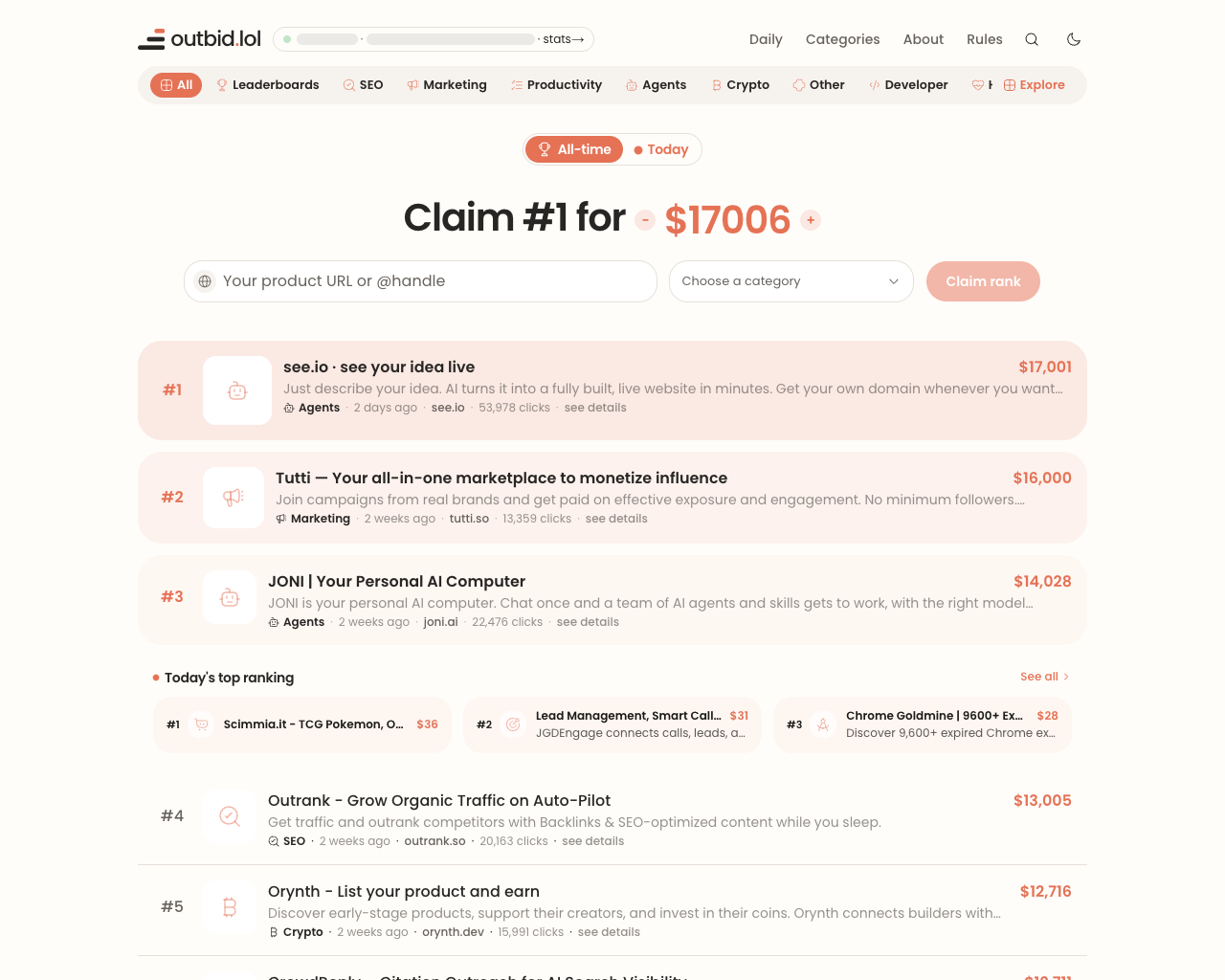
Shorter periods raised another question: would advertisers buy again after their positions expired? If the audience lost interest, resetting ranks would not restore the missing exposure. Separate boards changed the competition. A useful audience still needed ongoing work.
Sudden traffic also tested the service. The first-day report mentioned an analytics outage. Later came a request for help switching payment providers. The September 10 website FAQ named Dodo Payments as the provider.
Making a position people can buy is a start. Once people arrive, visits, payments, and delivery must keep working.
What was happening three weeks later?
By September 10, people were still joining. But daily boards had fallen from more than a hundred entries a day to the teens or a few dozen. Large bidding contests were less common. Small-budget tests continued.
The official daily boards listed 120–381 entries per day on August 21–27, versus 10–32 on September 3–9. There were rebounds: August 31 reached 402 before falling again.
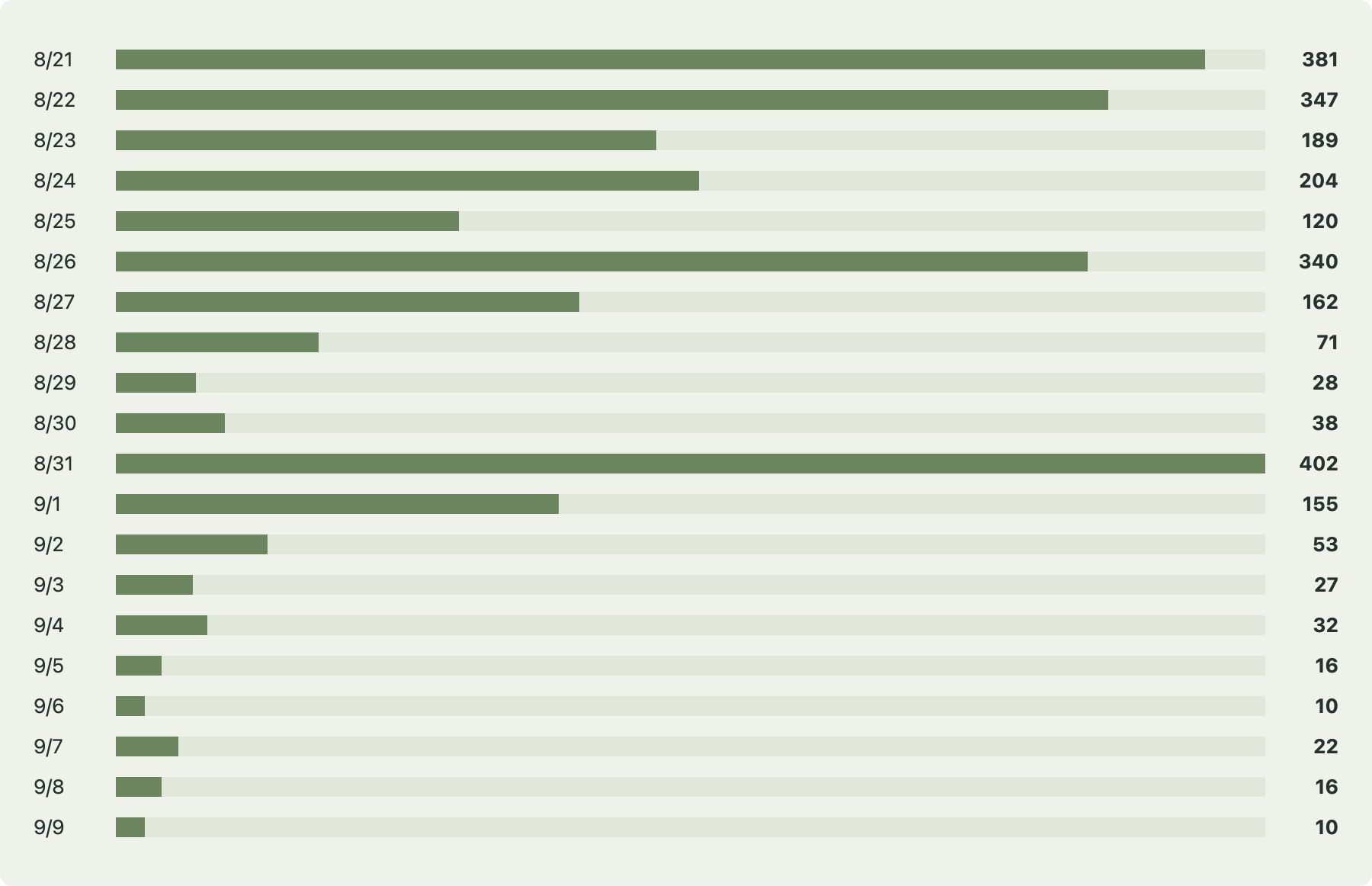
Daily entries, August 21–September 9 · Outbid Daily.
On those boards, see.io led with $15,000 on August 22, and Tutti reached $16,000 on August 24. By September 8, CertPost led with $72. OutSwipe led with $41 on September 9. Later buyers could still gain a daily rank with much smaller budgets.
Revenue also kept growing. outbid.fyi’s September 10 record put cumulative revenue at about $258,000. A recent Weird Revenue record was at a similar level. For an experiment meant to earn a few hundred dollars, that was a substantial result.
Yet a position costing a few dozen dollars was less likely to spark the discussion of a $10,000 bid. Early buyers got a place on the site and an unusual purchase to talk about. Routine small purchases depended more on suitable visitors from the site itself.
After the excitement faded, Outbid still had exposure to sell. The extra value of joining a big story was harder to repeat.
The product still gave smaller buyers a place. Shorter boards reduced the barrier from old high bids. Categories helped visitors find relevant products. Product pages kept the rank, amount, and share links. These features extended its use as a directory.
A useful next question was whether buyers spending $41 or $72 would share concrete results and buy again. Those stories could help bring in another round of buyers.
Why would buyers market an advertising platform?
Outbid turned product promotion into a contest other people wanted to watch. Jonathan brought an audience familiar with building businesses. Jack made a purchase look worth trying through early clicks. Lewis raised the stakes with $10,000. CrowdReply’s challenge and results gave others something to answer.
Three questions from this mix are useful for other businesses:
- Why does the first audience care? Jonathan’s followers already built products and sought customers. Copies needed that connection too.
- What can participants tell other people? Buyers could show ranks, prices, and results while introducing their own products. Joining gave them content with a reason to share.
- How does one success story help the next purchase? Buyer stories explained possible returns. Shorter boards made room to join. Both served the next decision more directly than another revenue total.
Companies buying a rank or sponsoring a popular event can learn from Comp AI and Outrank’s calculations. Set a budget based on customer value, then follow signups, trials, and demos through to sales. Plan how to tell the story of taking part so that the resulting content also serves the product.
Outbid’s striking feature was that buyers grew the advertising platform’s audience while promoting their own products. An existing audience, public ranks, unusual bids, and buyer results worked together. The useful design question is how to make participation rewarding for both sides.